Lunar Lander - 2009
| Lunar
Lander -
Celebrate the 40th anniversary of the moon landings with a more-real
than average game. 40 years ago Neil Armstrong may or may not have fluffed his lines as he stepped on to the moon. Could the anniversary be a better cause to do a Lunar Lander arcade game? Lunar Lander is my second "hand made" arcade machine, and is joins its cousin Cyclepong on Southwold Pier. I love Apollo era technology - all those banks of gages and switches and lights that flash. Very tactile unlike today's uniform monitors . Thunderbirds and other TV programmes of my childhood created a vision of a technical future that's so much more exciting that what we actually ended up with. For Lunar Lander I wanted to make a game that gives a friendly nod the past and also provides a different kind of entertainment to kids used to the sophistication of modern computer games. To land on the moon the Apollo astronauts had to use rocket thrust from the landing module to balance the gravitational pull, while also managing their landing position and fuel consumption. A tricky task (so much so that Apollo 11 landed with only 15 seconds of fuel remaining). This kind of moon landing inspired some of the very first computer games. The defining "Lunar Lander" game was Atari's vector graphics version from 1979. The floating motion of the lander and the smoothness of the vector graphics make it a hypnotic machine. |
 My lunar
lander (with spot-lights).
[Click image for full size] 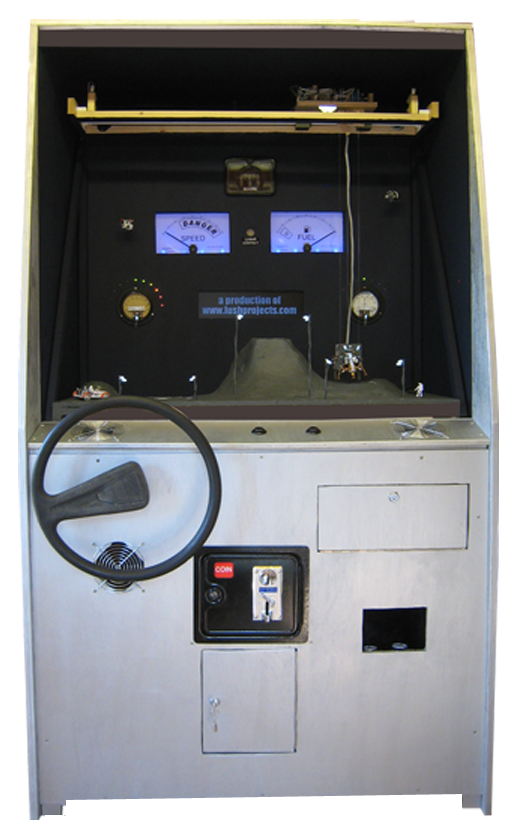 Lunar lander cabinet [Click image for full size] |
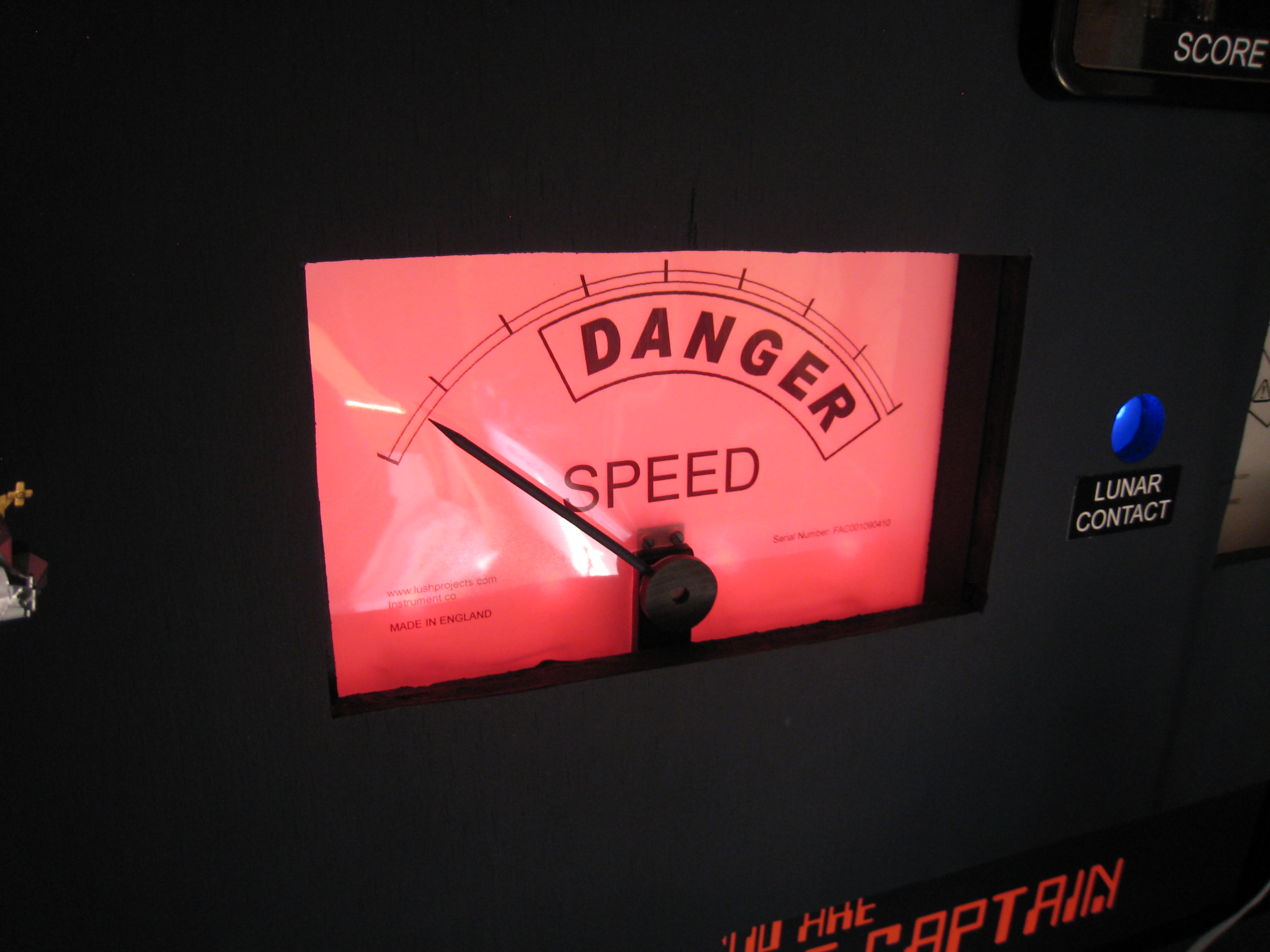
| Make it real Replacing Atari's vector graphics, my Lunar Lander is a model that hangs on fishing line and flys over a paper mache landscape. Stepper motors provide accurate control of the position and a servo controls the rotation. I won't claim the beautiful model making achieved by Thunderbirds, but the space-age look and visible wires certainly give it something of that feeling. Big dials (controlled by more servo motors) show the speed and fuel. These are backlit with LEDs that change colour when in the critical zone. Matching 'vintage' meters show the position and rotation of the lander model. Adding to the historical look there is a nixie tube display for the score. Lastly I couldn't quite get away without using a monitor, so there is a small LCD which has been masked off to give it an interesting aspect-ratio. A car steering wheel (actually from a 2 CV) is used to turn the lander with a simple button to fire the rocket. There is something magical about turning the wheel and seeing the model copy the turn. The best thing about showing the game is watching kids and adults getting transfixed. Having something real that moves adds something that the millions of pounds spent developing today's games can't match. With tongue in cheek the attract mode advertises "latest 3D technology". |
|
| Make
it special Everybody in business wants "stickiness". How do you keep people using your product and not wandering off to the competition? Lunar Lander has a particular problem here - in a physical model you can't keep inventing new challenges like you can on a video game. Fortunately some lunchtime discussions came up with a master plan that provides a nice end to the game and an incentive to play again. Anyone who successfully lands on the three landing sites will be rewarded with a "special medal" (it's a badge actually), and there are four designs so even if you've done it once you may still want to try again. Last but not least, the media loves to say that we live in a "celebrity obsessed world" (this means that they are obsessed with celebrities). Whether this is true or not, a famous name does help get attention - particularly when there is real talent there too. Only the best is good enough for Lunar Lander and due to a happy alignment of the planets Emma Freud was kind enough to record the voice samples. Players can enjoy her superbly weighted delivery instead of my mumbles. |
 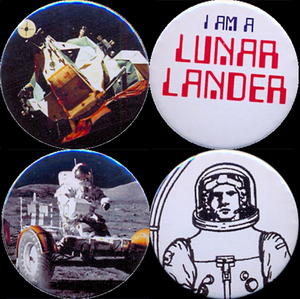 Medals
awarded for completing all three levels
|
|
|
|
| Make
it work (detail
for the techies!) I started thinking about Lunar Lander and acquiring parts in spring 2008, and started making things in early winter. To have something that was portable and easy to test with, I started out with just the mechanism and landscape as a unit. This would just about fit in my study so I could do the software indoors over the winter. The working prototype was ready in time for Maker Faire UK in March 2009. Final construction of the arcade version went on until summer 2009. The electronics for Lunar Lander are based around ATMEL AVR microcontrollers. An Arduino board acts as a convenient USB to serial converter which makes the computer interface nice and easy. All the microcontrollers listen to a common bus from the Arduino. The circuit boards are hand-wired on stripboard or tripad except for the nixie driver which needed a PCB to make the connections to the valve base of the nixies. I was trying to make life easy for myself by using lots of off-the-shelf parts. There is some slightly clever stuff in the AVR software which makes the stepper motors run very reliably at the right speed even if the speed is being varied during the game. Infrared sensors are used to detect the limits for the system. On power-up the game does a calibration to find out the positions on all the limits. After this it relies mostly on the stepper motor counts being correct to measure the position of the lander. This seems to work fine - even over very long runs of many hours. The speed and acceleration of the stepper motors are controlled to make sure that no stalls or missed-steps happen. The intelligence for the game and overall control is done on a PC. To try and save time I used Python as the development environment with PyGame providing the game framework. I really enjoyed Python. The power of the language and the range of libraries do make it a good for doing lots of work quickly. The mechanical parts came from various DIY stores, online shops and car boot sales. Construction was done with normal DIY tools but I did invest in a few things to make this easier. An electric mitre saw is invaluable for making good cuts, and a high quality cordless drill and screwdriver really speed things up. During the testing the mechanics have stood up pretty well. We'll see how well they survive the continuous use on the pier. There is lots more Lunar Lander construction info on the blog. |
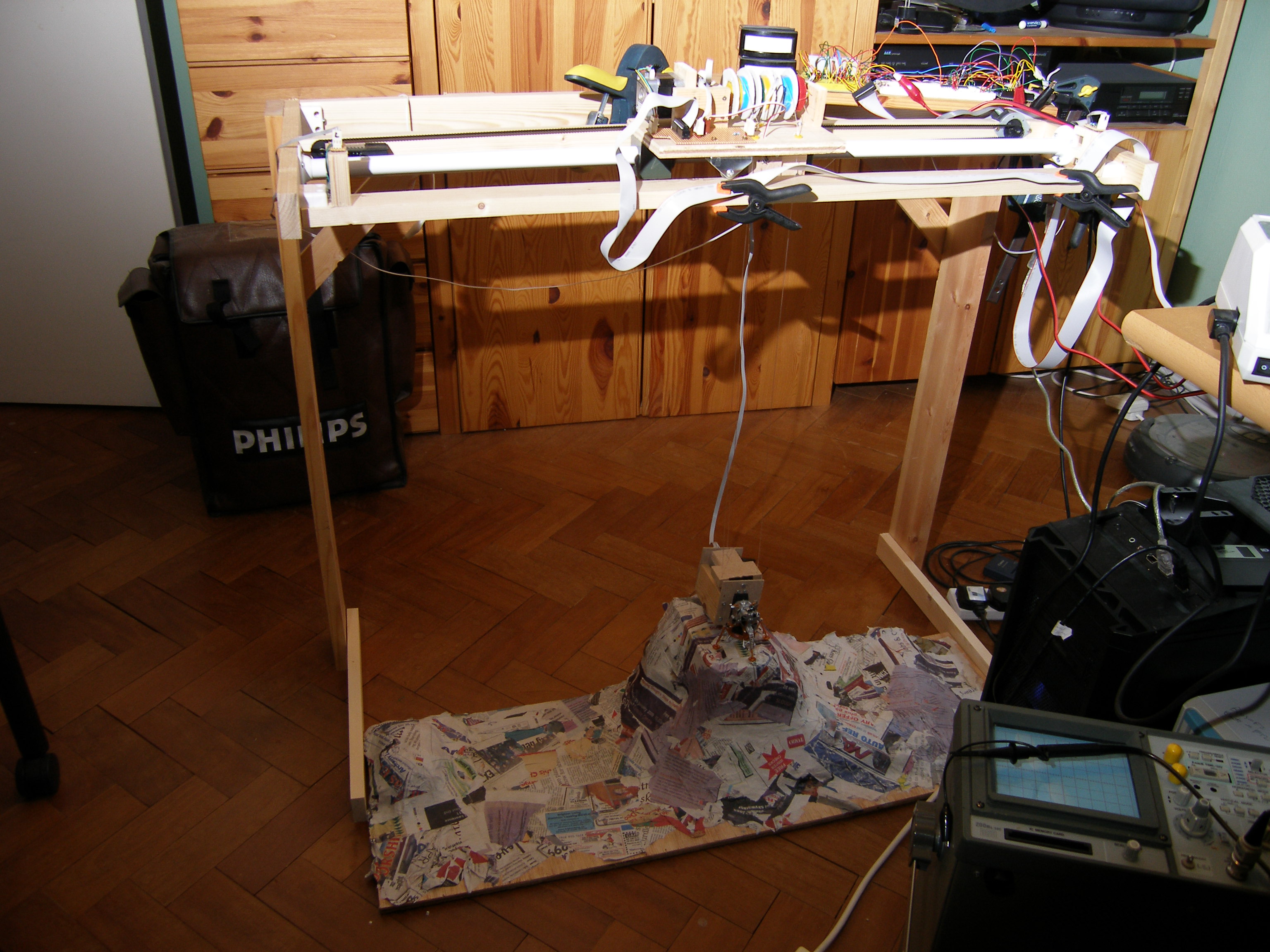 Early prototype [Click image for full size] 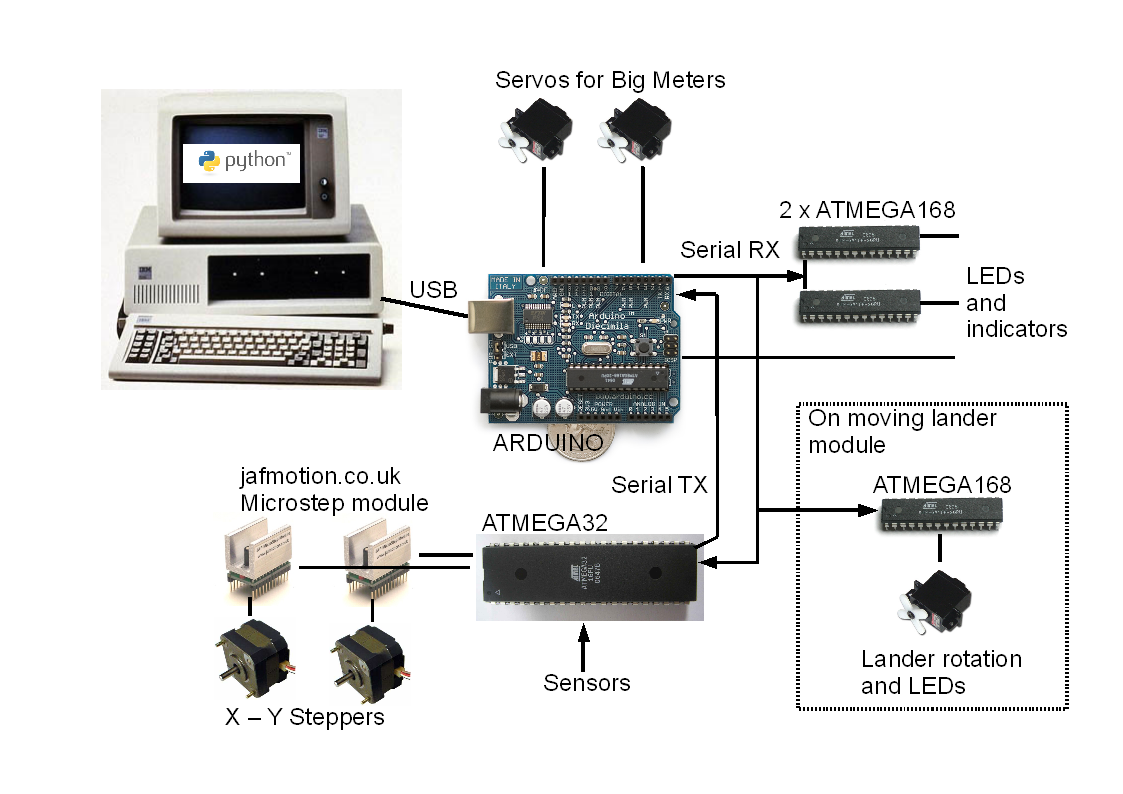 System architecture [Click image for full size] |
| Update - Feb 2011 Lunar Lander is back from Southwold Pier - moved out during an update to the arcarde. It was never as popular as Cyclepong, but I always loved it as a machine. It's a complicated beast and reliability has been mixed. Good fun to make and great to play if you liked the original. |
|